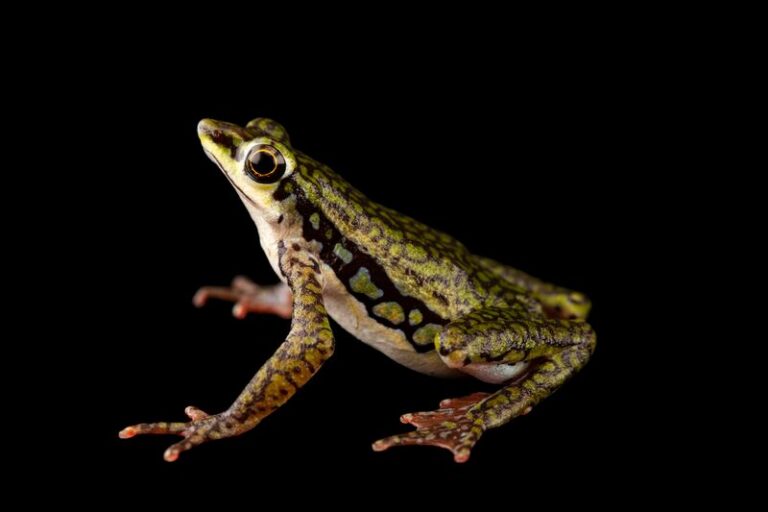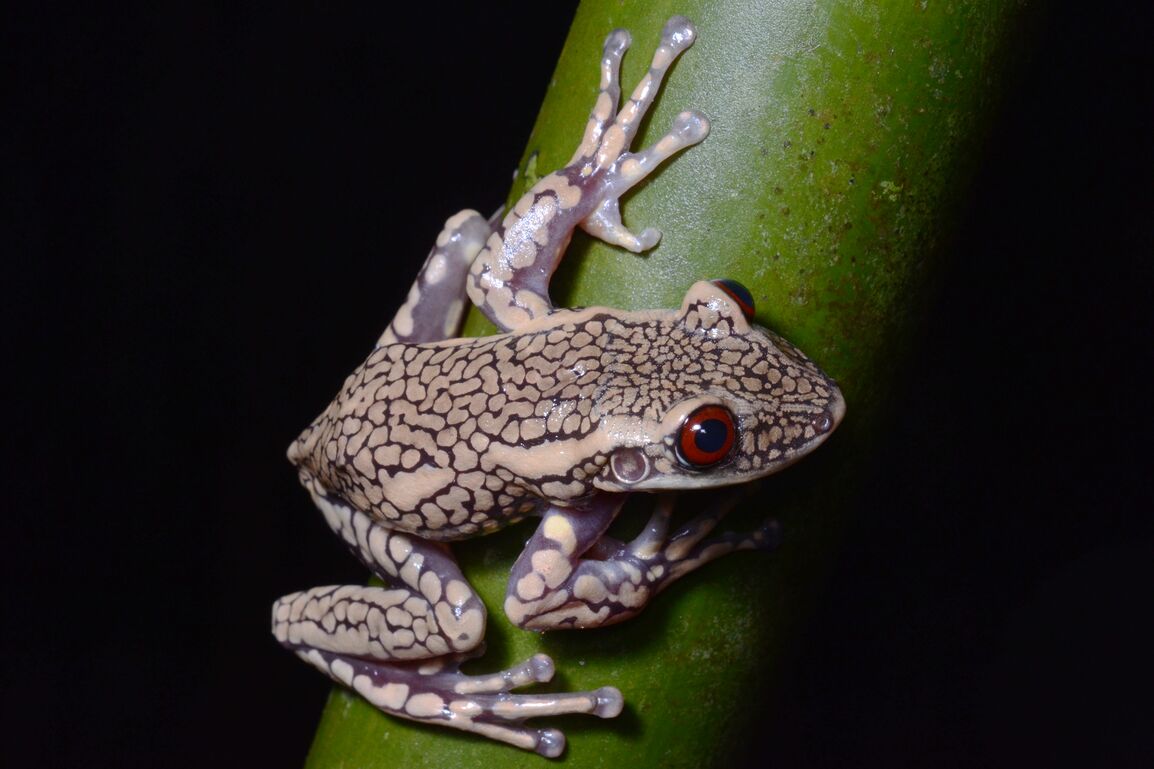
Casque-headed treefrogs are named for the bony plate that fuses with the skin on top of their head. Scientists believe that the frog uses its head to plug up a hole in a tree or plant to retain moisture and protect against predators.
The Casque-headed Painted Treefrog is known to live only in one small fragment of humid primary forest in the Brazilian state of Minas Gerais. Its entire remaining habitat is restricted to a five square kilometer area—all of which sits on the property of one farm. The actual extent of the species’ forest home may even be less than that, given the expected impact of the “edge effect” of ongoing deforestation, in which destruction accelerates on the edges of the forest that still stands.
As the frog’s name implies, it resides in trees making it hard to spot. The Casque-headed Painted Treefrog is thought to lay its eggs in water in tree holes, where its tadpoles then develop. The species has also been seen in non-native bamboo that grows in the area.
While researchers have looked for the species in nearby fragments of the Atlantic Forest, it has only ever been found in one location. Meanwhile, this forest fragment has shrunk by 20% since the 1980s, primarily due to clearing for livestock pastures. Other drivers of habitat destruction in the area include mining, conversion to cropland, expanding urban areas and fires that quickly burn out of control. In addition, bullfrogs have been found in nearby ponds, which may prey on Casque-headed Painted Treefrogs or spread the chytrid fungus, which causes a deadly infectious disease that has decimated amphibian populations worldwide.
While this species’ survival clearly depends on protecting and expanding the tiny habitat that remains, there is hope: In recent years a captive-breeding program started at the Wildlife Conservation Center of the State of São Paulo led to the first successful reproduction of the Casque-headed Painted Treefrog in captivity.
At a glance
Taxa
Amphibians
Geography
Brazil
Status
Critically Endangered
Habitat
Forest
Estimated Population
Fewer than 50 individuals
Threats
Industrial development; agricultural expansion; livestock encroachment into the forest; fires; illegal timber removal
Potential Recovery Actions
Habitat recovery; conservation breeding and reintroduction; translocation; invasive species control