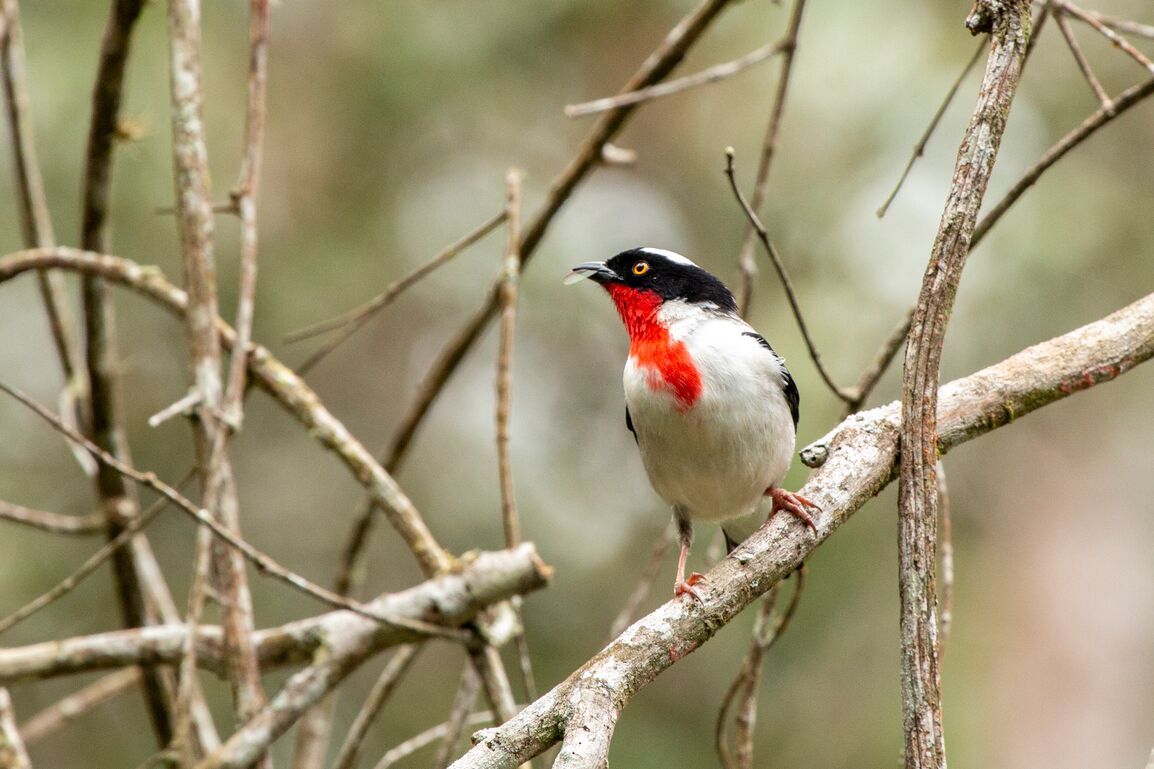
The Cherry-throated Tanager is a distinctive bird with a shock of red feathers on its throat, so it’s hard to imagine that the species was ever difficult to spot, but it was lost to science for decades! After scientists first observed the species in the late 19th century, the Cherry-throated Tanager had only one additional confirmed sighting before it was rediscovered in 1998 by a group of ornithologists in the Brazilian state of Espírito Santo. Scientists think that the species may have declined between 10% and 19% over just three generations due to clearing of their Atlantic Forest habitat.
The species favors humid, mountainous old-growth forest, where it forages in the high canopy, eats mostly invertebrates and makes nests from lichen and spider webs. Like many tanager species, the Cherry-throated Tanager has been observed in mixed-species flocks that can have as many as 30 different species.
The species’ habitat has been largely destroyed as humans have converted the forest to coffee plantations, mines and quarries, as well as cut down trees for timber, firewood and charcoal. It’s now only found in three small locations.While tanagers have been observed in pine and eucalyptus plantations, they typically only visit those areas while they are traveling between forest fragments. As a result, conservationists believe that conserving and restoring these patches of natural forest is critical for the Cherry-throated Tanager’s survival. In 2021, several organizations worked together to create a 285-hectare (704-acre) protected area that will safeguard crucial habitat for the species.
At a glance
Taxa
Birds
Geography
Brazil
Status
Critically Endangered
Habitat
Montane Atlantic Forest
Estimated Population
Fewer than 50 mature individuals
Threats
Habitat destruction and degradation; forest fragmentation; small population size
Potential Recovery Actions
Habitat protection; research and monitoring