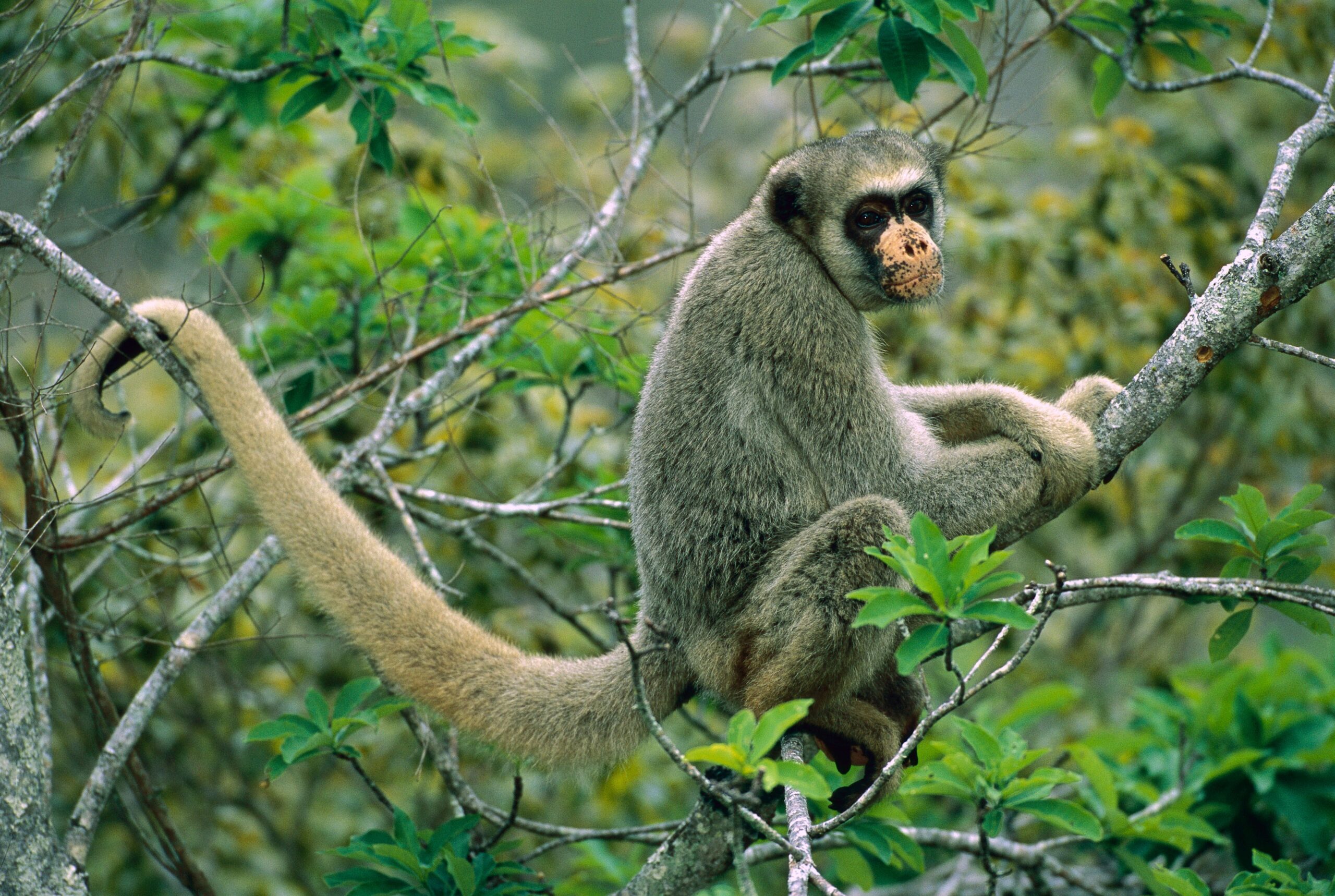
The Northern Muriqui is South America’s largest primate and it is often called the “hippie monkey” because the species prioritizes peace over conflict. The monkeys are often seen hugging each other with their long arms that they use to swing through the trees of the Atlantic Forest in Brazil, and don’t seem to experience conflict very often. Northern Muriquis don’t have a social hierarchy, unlike many other primate species, and their social dynamics are more egalitarian.Troops of the monkeys will even start their days with a group hug and keep in close physical contact throughout the day, especially as they eat.
Females typically leave their natal troops when they reach maturity and are ready to breed. Males don’t compete with each other for breeding access to females. Instead, they will sometimes gather together to attract females and each will wait patiently for a chance to breed with the females. The breeding season is during the wet season and babies are born during the dry season.
Northern Muriquis can live in large troops, sometimes numbering as many as 80 monkeys. In the canopies of the forests where they live they eat leaves and fruit with a smattering of flowers, seeds, tree bark and buds. However, there are only about 1,000 Northern Muriquis living in the wild in Brazil across 14 subpopulations, which makes it one of the most threatened primates in the world. The subpopulations are isolated from each other and scientists warn that many of the smaller subpopulations may not have enough adults to survive.
The biggest threat to the Northern Muriqui is the destruction of the forests where it lives for agriculture and growing urban areas.
At a glance
Taxa
Mammals
Geography
Brazil
Status
Critically Endangered
Habitat
Atlantic Forest
Estimated Population
Fewer than 1,000 individuals
Threats
Habitat loss; forest fragmentation
Potential Recovery Actions
Protected area management; habitat restoration; improve connectivity between forest fragments; population monitoring; conservation research