At a Glance
Where in the world is the Whitespotted Wedgefish? Scientists are trying to learn more about this shark-like ray. It’s a species with many aliases— sometimes called a shovelnose shark, guitarfish, bottlenose shark, sandshark or fiddler. This elusive ray can be difficult to tell apart from other similar-looking species of wedgefish. It lives across vast swaths of ocean—from Mozambique in the Indian Ocean to the Solomon Islands in the Pacific Ocean. It lives in subtropical coastal waters with sandy bottoms, though it can also be found at depths of up to about 200 feet on the continental shelf (60 meters).
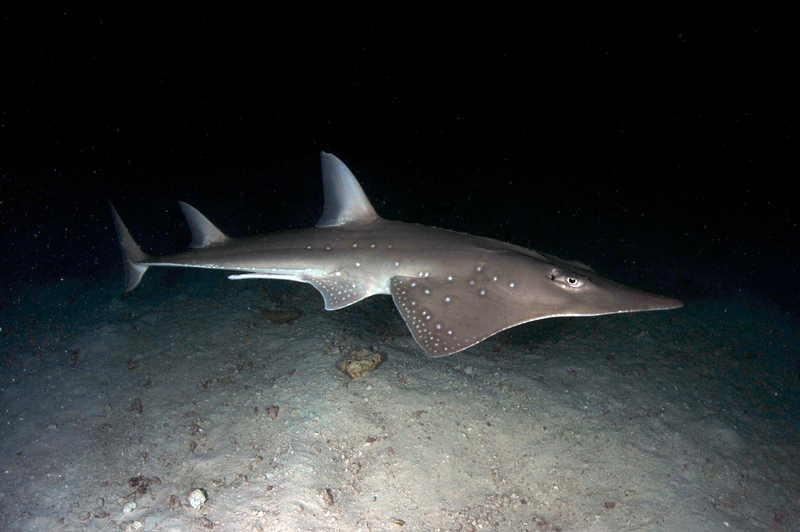
As its name suggests, the Whitespotted Wedgefish has a head and pectoral fins that create a triangular shape—making the front of its body look more similar to a ray with a bottle-shaped snout. The posterior half of its body looks more similar to a shark, with tall dorsal fins and a tail that it uses to propel itself forward in the water. The Whitespotted Wedgefish has a dark gray to nearly black body with white spots and a pectoral fin with a black spot and three white spots above it.
Scientists and conservationists are still learning about the behavior and reproduction of the Whitespotted Wedgefish. Females usually give birth to between seven and 19 pups in a litter and the pups hatch from eggs that develop inside the females’ bodies. Whitespotted Wedge fish grow slowly, but when they are fully grown they reach up to 10 feet in length (three meters).
The Whitespotted Wedgefish eats crabs, molluscs and small bottom-dwelling fish. It can easily be swept up and killed by fishing nets that drag or trawl along the sea bottom, and the species is a target for the shark fin trade. Scientists believe that the shark fin trade and an increase in fishing has caused the population to decline.
At a glance
Taxa
Sharks and Rays
Geography
Indo-West Pacific
Status
Critically Endangered
Habitat
Subtropical coastal waters
Estimated Population
Unknown
Threats
Extreme overfishing, bycatch and the shark-fin trade
Potential Recovery Actions
Establishing marine protected areas where fishing is not allowed or the type of fishing nets used is regulated, curbing the shark-fin trade, conservation breeding and population reinforcement.