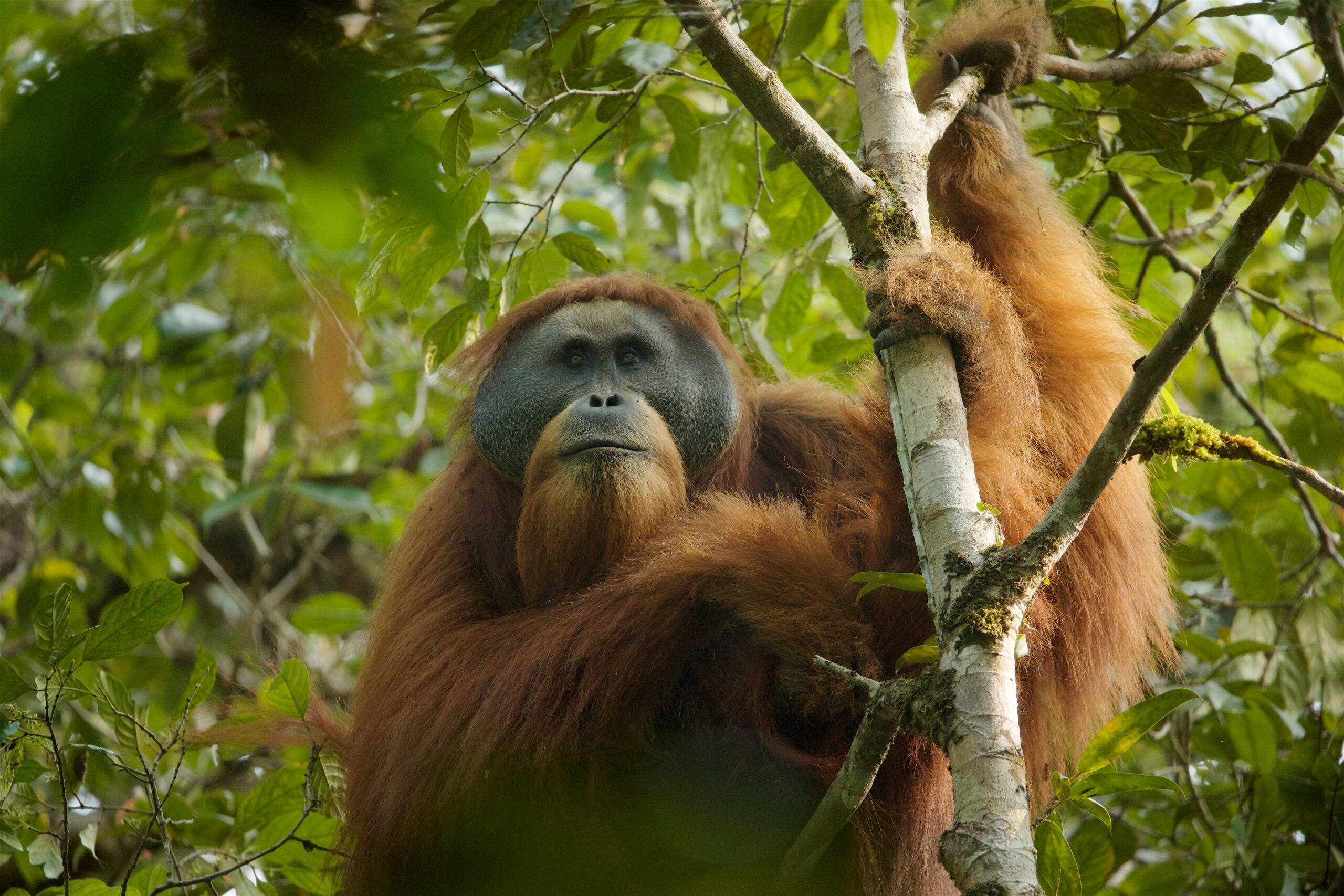
Described by science for the first time in 2017, the Tapanuli Orangutan has the unfortunate distinction of being the world’s rarest (and most threatened) great ape species, though all great ape are listed as either Endangered or Critically Endangered on the IUCN Red List of Threatened Species. Fewer than 800 individual Tapanuli Orangutans survive in the rainforests of Batang Toru, a biodiversity-rich ecosystem in North Sumatra Province, Indonesia.
The Tapanuli Orangutan differs slightly from its cousins—the Bornean and Sumatran Orangutans—in both appearance and behavior. The species’ recent discovery also marks a fascinating twist in the narrative of the tree of life, because genetic tests revealed that the Tapanuli Orangutan is actually the oldest of the three orangutan species from an evolutionary perspective. This means the Tapanuli Orangutan has lived in the tropical forests of southeast Asia for more than three million years. Today, they are tragically close to being lost forever.
Like other orangutan species, the Tapanuli Orangutan is threatened by habitat loss and hunting. The forests they depend on have been fragmented by forest clearing, roads, human development, hydropower dams, mining, and industrial crop expansion. . Despite being protected by strong national laws , Tapanuli orangutans are also hunted—sometimes for food, sometimes in retaliation for destroying and eating crops, sometimes for the illegal pet trade. The Tapanuli orangutan’s range is restricted to a small area of Sumatra. It’s a critically endangered species existing within a sea of humanity and industrial projects, thus even small shocks to its population and habitat can have devastating impacts.
At a glance
Taxa
Mammals
Geography
Indonesia
Status
Critically Endangered
Habitat
Tropical forest
Estimated Population
Fewer than 800 mature individuals
Threats
Habitat loss and fragmentation, hunting, conflict with humans, infrastructure development
Potential Recovery Actions
Habitat protection and management, monitoring and research, community-based conservation